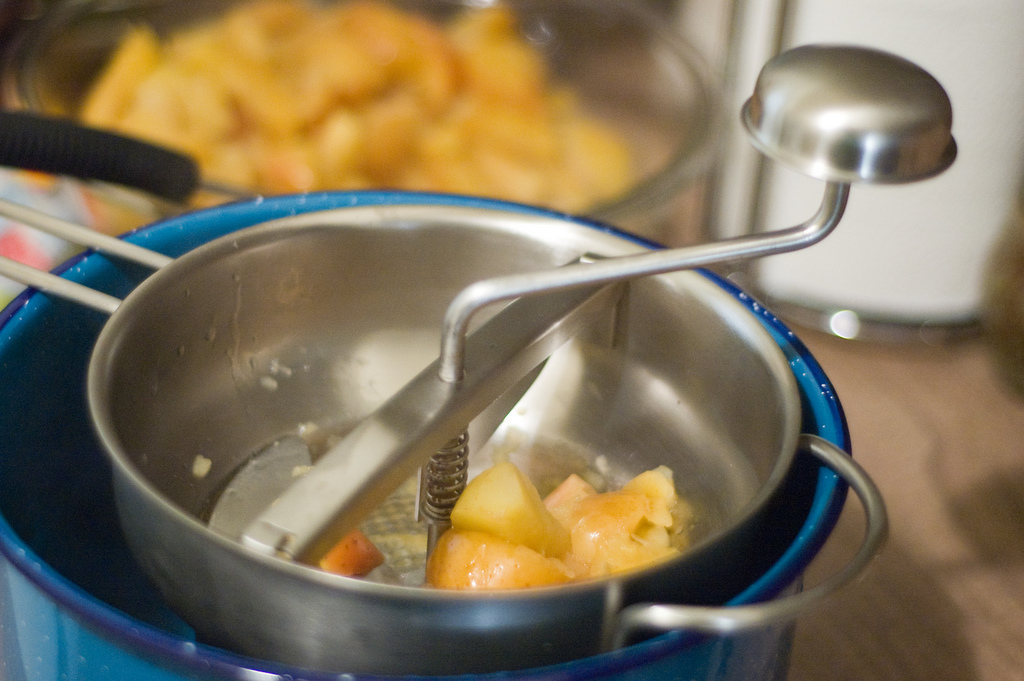
A food mill is one of those tools you may not use very often, but you’ll be glad to have one when you need it. Making apple sauce (or apple butter), mashed potatoes, and separating seeds and skins from tomatoes are three main uses for a food mill.
HOW IT WORKS
A bowl-shaped hopper holds the food to be milled. A hook and a handle help secure the hopper over a separate bowl to catch the milled food. A hand-driven crank pushes an angled paddle, which smears and forces the food through a disk. The disk, perforated with colander like holes, strains the food, separating out the unwanted bits (seeds, skins, etc).
HOW TO CHOOSE A FOOD MILL
The best models feature deep hoppers and paddles that fit snugly against the disks. They come apart easily for cleaning and have interchangeable disks with various hole sizes, so you can control how finely strained your food is. We particularly like two models. The Cuisipro Deluxe food mill ($105, available from Sur La Table) has three disks (2 mm, 3 mm, and 4 mm) and a little rotating scraper on the underside of the disk that knocks the food off as you turn the handle. The Rösle food mill ($117, available from RosleUSA.com) comes with two disks (1 mm and 3 mm), and several other sizes are available for purchase. An antifriction pad between the paddle and disk makes it slightly easier to operate than the Cuisipro.
COOK’S TIP:
If the disk becomes clogged during milling, turn the crank backwards, and the paddle becomes a scraper that clears the clog.
There are no comments
Add yours